Quantum Internet: The Next Web You Can’t Hack

Table of Contents
1. Introduction: A New Era of the Internet
The internet we use today was never truly designed for airtight security. Over the decades, we’ve layered it with encryption, firewalls, and authentication systems, but sophisticated cyberattacks still find ways to break in. From state-sponsored hackers to zero-day exploits, the risks are ever-present.
Enter the Quantum Internet — a revolutionary approach to communication that leverages the laws of quantum physics to make eavesdropping virtually impossible. Unlike the current web, which relies on classical data transfer, the Quantum Internet will transmit information using particles of light (photons) in quantum states.
Here’s the catch: if someone tries to intercept your quantum data, the mere act of looking at it will alter its state — instantly revealing the breach. It’s not just secure; it’s security woven into the very fabric of reality.
2. How the Quantum Internet Works
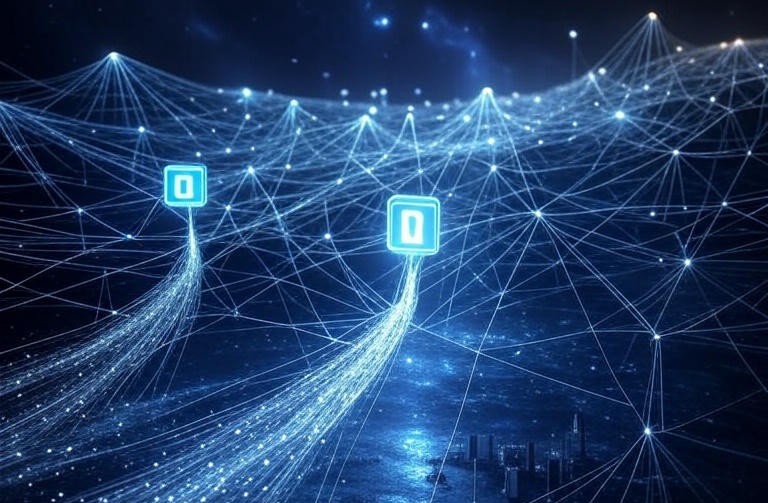
To understand the Quantum Internet, we need to shift from thinking in bits (0s and 1s) to qubits, the building blocks of quantum communication.
A qubit can be in a state of 0, 1, or both at the same time, thanks to a principle called superposition. Combine that with entanglement — a phenomenon Einstein famously called “spooky action at a distance” — and you unlock a communication system where two particles share a linked state, no matter how far apart they are.
Here’s why this matters:
- Instant Tamper Detection: If someone tries to intercept or measure an entangled photon, its quantum state collapses, and both sender and receiver know the connection has been compromised.
- Quantum Key Distribution (QKD): This technique uses quantum states to share encryption keys with unbreakable security. Once a key is shared, any interception attempt destroys it.
- Photonic Transmission: Instead of sending electrons through copper or signals via radio, the Quantum Internet transmits photons through fiber-optic cables or even via satellites — drastically reducing certain vulnerabilities of classical systems.
A simplified flow of Quantum Internet communication looks like this:
- Sender prepares qubits in specific quantum states.
- Qubits are transmitted through a quantum channel (fiber or free-space optics).
- Receiver measures the qubits, generating a secure encryption key.
- Any interception attempt during transmission alters the qubits, triggering an instant alert.
While this sounds like sci-fi, major institutions like China’s Micius satellite project, DARPA’s quantum network experiments, and EU’s Quantum Internet Alliance have already demonstrated working prototypes of this technology.
3. Why the Quantum Internet Is Considered “Unhackable”
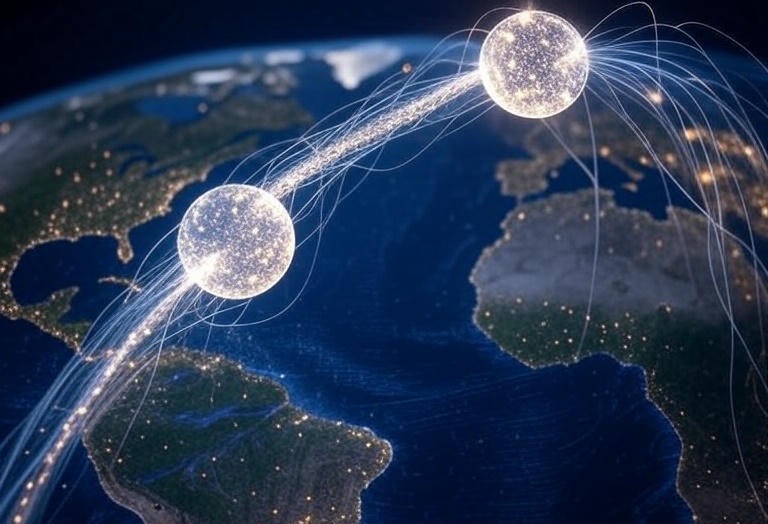
The Quantum Internet has earned the nickname “The Web You Can’t Hack” for a reason — it doesn’t just make hacking harder, it changes the rules of the game entirely.
In traditional networks, data is protected by mathematical encryption. Given enough computing power (or a breakthrough algorithm), even the strongest encryption could theoretically be cracked. Quantum computers are already threatening these defenses.
The Quantum Internet flips the paradigm:
- No Data Without Permission: When a qubit is measured or intercepted, its quantum state collapses. This isn’t a bug — it’s a fundamental law of physics.
- Eavesdropping Detection: If an attacker tries to read the quantum transmission, the intrusion becomes instantly visible to both parties.
- One-Time Keys, Always Fresh: With Quantum Key Distribution (QKD), encryption keys are generated on the fly and discarded after use. Even if someone recorded the data, it would be useless without the original key — and that key ceases to exist after a fraction of a second.
Imagine sending a secret through a glass tube where the moment anyone even touches the tube, the contents vanish — and you get an alert telling you exactly where it was touched. That’s how the Quantum Internet protects information.
Real-World Proof
- China’s Micius Satellite has already transmitted QKD keys between Beijing and Vienna, spanning thousands of kilometers.
- University of Delft in the Netherlands has successfully entangled qubits between three separate locations, a key step toward full-scale quantum networking.
- Governments and defense organizations are investing billions to build early-stage quantum-secure communication systems, not for luxury — but for survival in the coming cyber landscape.
In short, the Quantum Internet doesn’t just promise security. It offers provable security, enforced by the laws of quantum mechanics themselves.

4. Potential Applications Beyond Security
While the Quantum Internet is often framed as a cybersecurity breakthrough, its potential impact stretches far beyond keeping secrets safe. The technology could redefine how industries share data, collaborate, and even innovate.
1. Global Scientific Collaboration
Today, scientists exchange vast amounts of sensitive data — from genomic sequences to climate models — over the classical internet, often risking leaks or tampering. A quantum network would allow researchers across continents to share information with absolute assurance that no one else can intercept or modify it.
- Imagine climate scientists in Antarctica streaming real-time measurements to labs in Tokyo and New York, with zero chance of interception.
- Or physicists conducting simultaneous quantum experiments across the globe in perfect synchronization.
2. Quantum Cloud Computing
A secure quantum network could enable cloud services to host quantum computers accessible from anywhere in the world — without risk of data theft. Researchers and businesses could rent quantum processing time, send encrypted quantum queries, and receive results instantly, without exposing the algorithms or the data.
3. Financial Transactions & Banking
The global financial system thrives on speed and trust. With the Quantum Internet:
- Banks could transfer funds with unbreakable encryption.
- Stock exchanges could execute trades where no third party can snoop on market-moving information before it’s public.
- International transactions would be immune to man-in-the-middle attacks.
4. Next-Generation Telemedicine
Quantum networks could allow hospitals to transmit highly sensitive patient records, DNA profiles, and even live surgery feeds to specialists worldwide — instantly and securely. This would make remote surgery and collaborative diagnostics far more viable.
5. Secure Government and Military Communication
From embassy to headquarters, every conversation could be shielded with QKD. For military operations, this means that strategic commands can be issued without fear of interception, even by the most advanced adversaries.
6. Distributed AI Development
AI training often requires pooling data from multiple sources — which raises major privacy concerns. A quantum network could allow AI models to be trained collaboratively across institutions without exposing raw data, protecting both privacy and proprietary algorithms.
In short, the Quantum Internet could underpin the trust layer of the future digital economy, enabling new industries while safeguarding existing ones.
You can check more details in the pdf version below
5. Challenges in Building the Quantum Internet
For all its promise, the Quantum Internet isn’t just a “plug-and-play” upgrade to today’s infrastructure. The journey from research labs to global deployment is packed with complex engineering problems, scalability hurdles, and real-world constraints.
1. Maintaining Quantum States Over Long Distances
Quantum bits, or qubits, are notoriously fragile. The slightest disturbance — heat, electromagnetic interference, even a stray vibration — can cause them to lose their state, a phenomenon called decoherence.
- While optical fibers can carry photons for kilometers, the signal decays far faster than in classical networks.
- Quantum repeaters, devices designed to extend quantum communication, are still in their infancy. Building a chain of reliable repeaters is one of the biggest engineering milestones.
2. Lack of a Global Quantum Infrastructure
Unlike the classical internet, which rides on decades-old backbone cables and satellite systems, there’s no equivalent infrastructure for quantum communication.
- Installing specialized fiber optic lines or satellite-based quantum channels requires massive investment.
- Countries will need to collaborate — or risk creating fragmented “quantum islands” that can’t talk to each other.
3. Integration with the Classical Internet
For the foreseeable future, the Quantum Internet will coexist with the classical internet.
- This means hybrid systems must be developed to handle both quantum and classical data securely.
- Developing interface protocols that allow quantum-encrypted messages to be sent across today’s networks without breaking security is a major challenge.
4. Scalability & Cost
The equipment needed — single-photon sources, detectors, cryogenic cooling systems — is expensive and delicate.
- To scale globally, production costs must drop significantly.
- Maintenance complexity is also an obstacle; you can’t send a quantum network engineer to every rural fiber node.
5. Standardization & Interoperability
Just like the early days of the internet had competing protocols, the Quantum Internet faces a standards problem.
- Without universal protocols, different quantum networks might not be able to interconnect.
- The International Telecommunication Union (ITU) and other bodies are working on this, but global agreement will take time.
6. Talent Shortage
Quantum engineering is still a niche skill set. The number of experts capable of designing, deploying, and maintaining quantum networks is tiny compared to the scale needed for global rollout.
7. Security in the Transition Period
Ironically, the shift to a quantum-secure world will be the riskiest time for cybersecurity.
- Until quantum-safe encryption becomes universal, attackers could store encrypted data now (“store now, decrypt later”) and break it once quantum computers are ready.
- The challenge is upgrading billions of devices worldwide before that window closes.
In short, building the Quantum Internet is not just about science — it’s about creating an entire ecosystem of hardware, software, policy, and global cooperation.
6. Global Efforts & Early Implementations
The Quantum Internet might sound futuristic, but its foundations are already being laid by governments, universities, and private companies across the globe.
1. China’s Quantum Leap
China is a recognized frontrunner in quantum communication.
- In 2017, the Micius satellite demonstrated the world’s first space-to-ground quantum key distribution (QKD) link.
- China has since built a 2,000 km quantum fiber network between Beijing and Shanghai, enabling secure communication between government and financial institutions.
- They aim to expand this into a pan-Asian quantum network by the early 2030s.
2. Europe’s EuroQCI Project
The European Quantum Communication Infrastructure (EuroQCI) is a continent-wide effort to create a secure quantum communication backbone.
- Uses both fiber networks and satellite QKD links.
- Partnering with the European Space Agency to integrate quantum tech into existing satellite infrastructure.
- Designed to protect critical infrastructure, defense communication, and banking systems.
3. The US Quantum Strategy
The United States, under the National Quantum Initiative Act, is pouring billions into quantum research.
- DOE Quantum Internet Blueprint outlines connecting national labs, universities, and private research centers via quantum links.
- Companies like IBM, Google, and AT&T are working on hybrid quantum-classical networking solutions.
4. Japan’s Metro-Scale Quantum Trials
Japan is experimenting with quantum-secured communication in dense urban areas.
- Tokyo and Osaka are running quantum metro networks linking government offices and research facilities.
- They’re also exploring quantum cloud computing over secure channels for corporate clients.
5. Private Sector Pioneers
- Toshiba: Leading in quantum key distribution hardware.
- ID Quantique: Commercializing QKD for banks and telecom companies.
- Xanadu & PsiQuantum: Building quantum computers that can directly integrate with quantum networks.
6. Multinational Collaboration
Several joint projects aim to connect quantum nodes across borders:
- The Quantum Internet Alliance (QIA) in Europe.
- Asia-Pacific Quantum Network connecting Japan, Singapore, and Australia.
- NIST-led working groups for global encryption standards.
Why This Matters Now
The groundwork being done today will determine who leads the next era of secure communication. Much like the early internet, the nations and companies that move first in the quantum race will shape the rules — and possibly dominate the technology for decades.

7. The Road Ahead — Opportunities & Risks
The Quantum Internet promises to revolutionize digital communication, but like any groundbreaking technology, it brings both unprecedented opportunities and significant risks.
Opportunities:
- Unbreakable Security: At its core, quantum communication offers security guaranteed by physics, a game-changer for governments, businesses, and individuals.
- New Business Models: Quantum cloud computing, ultra-secure financial transactions, and collaborative AI training could redefine entire industries.
- Scientific Breakthroughs: Quantum networks enable experiments and data sharing impossible with classical internet, accelerating discoveries in physics, medicine, and climate science.
- Digital Sovereignty: Countries leading quantum infrastructure can protect their citizens’ data and maintain strategic technological independence.
Risks and Challenges:
- Technological Complexity: Quantum hardware remains fragile and expensive; breakthroughs are needed before mass adoption.
- Geopolitical Tensions: The race to quantum supremacy could deepen tech divides, creating “quantum cold wars” with national security implications.
- Transition Vulnerabilities: As classical encryption weakens but quantum networks remain limited, there’s a dangerous window where data could be harvested now and decrypted later.
- Ethical and Privacy Concerns: Quantum tech could empower new forms of surveillance or digital control if misused by authoritarian regimes.
- Dependence on Infrastructure: The global digital economy’s growing reliance on quantum networks means failures or attacks could have catastrophic effects.
What Can You Do?
- Stay Informed: Follow developments from credible research labs and government agencies.
- Prepare for Hybrid Security: Begin adopting quantum-safe encryption methods as they become standardized.
- Engage in Policy Dialogue: Support ethical frameworks and international cooperation to prevent misuse and ensure equitable access.
- Explore Quantum-Ready Tech: For developers and businesses, experimenting with early quantum APIs and cloud services can build valuable expertise.
The Quantum Internet represents a leap not just in technology but in how we conceive trust and privacy in the digital age. Navigating this brave new world will require technical innovation, ethical vigilance, and global collaboration.

FAQS
Q1: What makes the Quantum Internet more secure than the classical internet?
A1: The Quantum Internet uses quantum properties like entanglement and superposition. Any attempt to intercept or measure quantum data changes its state, immediately revealing eavesdropping — something impossible on classical networks.
Q2: Is the Quantum Internet already available for public use?
A2: Not yet. While prototypes and limited networks exist (like China’s Micius satellite), a fully operational global Quantum Internet is still in the research and development phase, expected to roll out gradually over the next decade.
Q3: Can quantum computers hack the current internet?
A3: Potentially yes. Quantum computers can break many classical encryption schemes that secure today’s internet, which is why developing quantum-safe encryption and the Quantum Internet is critical.
Q4: How will the Quantum Internet affect everyday users?
A4: Initially, benefits will be seen in sectors needing ultra-secure communication — governments, banks, healthcare. Over time, consumer devices and services may adopt quantum-secure technologies, offering enhanced privacy and security.
Q5: What are the biggest challenges to building the Quantum Internet?
A5: Key challenges include maintaining fragile quantum states over long distances, creating global quantum infrastructure, integrating with classical networks, and reducing high hardware costs.
Conclusion
The Quantum Internet promises to fundamentally transform the way we communicate and secure data. By harnessing the bizarre yet powerful laws of quantum physics, it offers security that’s provable, instantaneous, and fundamentally unbreakable — a true game changer in an era of escalating cyber threats.
Yet, this revolutionary technology is not without its hurdles. From fragile quantum states and high costs to geopolitical challenges and ethical concerns, building a global quantum network demands unprecedented collaboration, innovation, and vigilance.
For businesses, governments, and individuals alike, the best approach is to stay informed, prepare for transition, and embrace emerging quantum-safe technologies. The race to quantum internet supremacy is underway — those who understand and adapt early will shape the future digital landscape.
Experiment, innovate, and remain vigilant — the next web is coming, and it’s more secure than anything we’ve seen before.